
Our business is guiding visitors to yours
Call 061 338 588
Women lead travel decisions. The practical question for a tourism business is where that influence can be met — and two years of consumer research point to the in-destination moment, and to print.
The influence of women in travel is well documented. Skift Research puts the share of travel decisions made by women at 82%, and other published studies place the share of leisure travel planned and booked by women at 70–80%. Whichever figure a marketer prefers, the conclusion holds: the decision about where to go, what to do there and what to spend it on is most often made by a woman — travelling solo, or as the primary influencer within a couple, within a family, or among friends. 
Where that influence becomes reachable is the more useful question. Most Irish tourism businesses are locally rooted and marketing to a general audience rather than to an identified traveller. Contact with an incoming visitor often begins on arrival, which makes in-destination an essential marketplace for attractions, activity providers, transport operators, visitor-facing retailers, and destinations themselves — counties, cities, and towns.
The Visitor International Consumer Survey 2024–2026 shows who is in that marketplace. Among everyone who used a visitor brochure, map or guide, 63% were women. Of those women, 99% were travelling independently rather than on a tour — the FIT audience that arranges its own days and chooses in-destination. Within that, 51% were travelling with family, 30% with a spouse or partner, 8% solo and 8% with friends. In each of those situations, the person holding the printed information is the one whose choices set the days ahead.
Timing is the clearest signal in the data. Of the women who used a brochure, map or guide, 83% used it after arriving — either in-destination only, or in-destination as well as during planning. Print does much of its work once the trip is underway, when the plan is still open and something is being chosen.
That is where the commercial value sits. The person choosing and the person influencing spending are the same person, in the same place, holding a brochure they chose themselves — acting on it within the hour, or in the days that follow.

How these visitors travel matters as much as when they decide. Among the women using printed visitor information, 72% were travelling by their own car or a rental car, and a further 6% were exploring on foot. Their route is theirs to set and theirs to change.
That mobility is what converts an in-destination pick-up into a visit. A traveller with a car and an open plan can act on something discovered in a hotel lobby that same day, or return to it later in the trip, and can add a stop that was not on any list that morning. For a business a short drive from where the display stands, this is the audience with both the interest and the means to arrive.
The survey asked brochure users to confirm which specific effects the printed information had on their trip. Among women the pattern is consistent, and it is weighted towards discovery.
How printed visitor information influenced the trip — women who used a brochure, map or guide
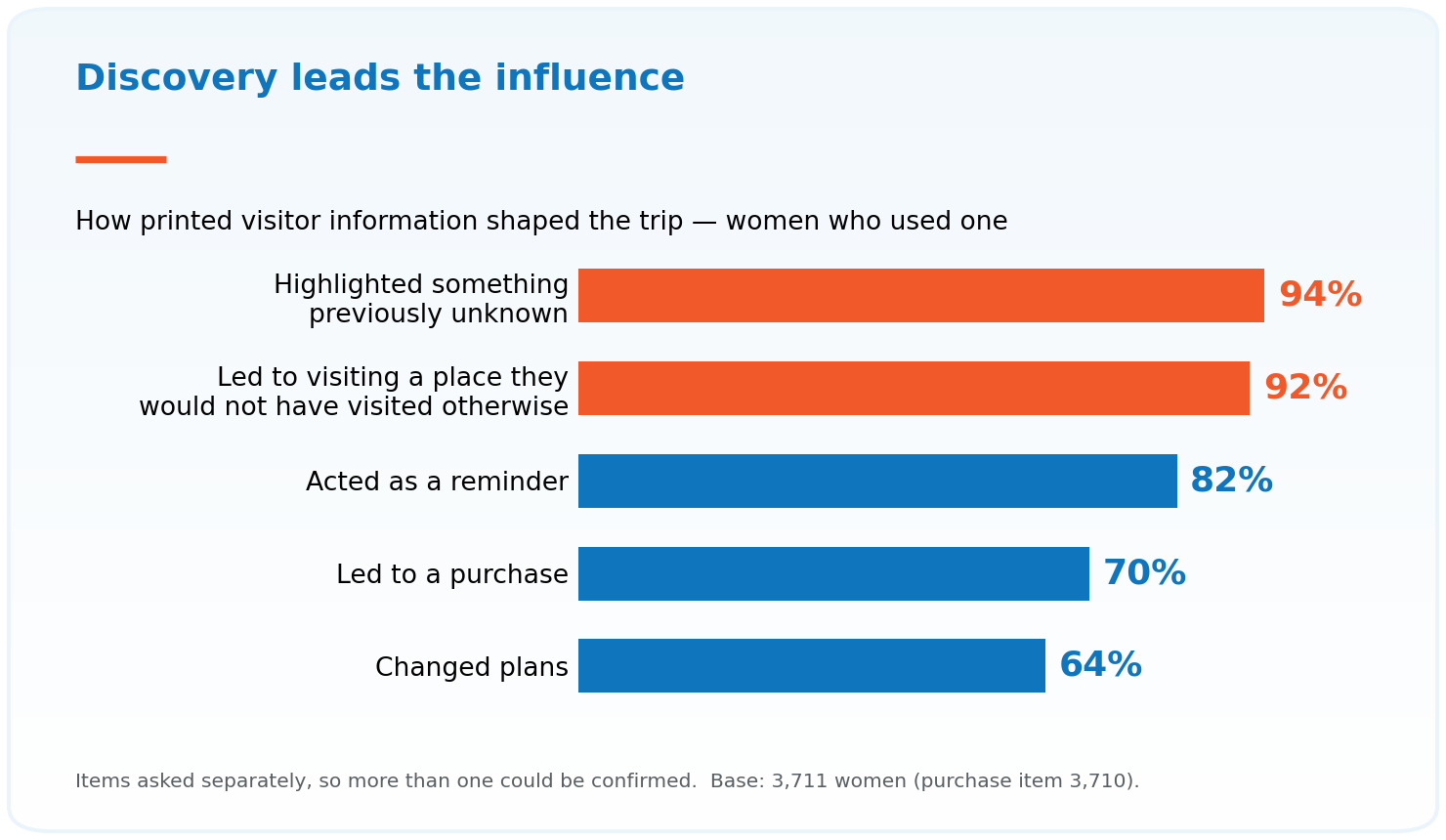
The top two lines are where the money is, because in both cases the visitor would not have found the business without the brochure. A search engine answers the question a visitor already knows to ask. An in-destination display supplies what comes before the question — the name, the offer and the reason to go. Below that, the purchase and plan-change figures show what happens when discovery meets time to act. Fully 89% of these women confirmed at least three of the five influences and 44% confirmed all five, while 80% rated the printed information they used extremely or very valuable.
The mechanism is simple: print puts a business in front of visitors while they are still deciding what to do, and for most of them it is the first time they have heard of it.
Print and digital run in sequence in-destination, and the data shows which one often starts the sequence. Among women who used a brochure, map or guide, 89% said something they saw prompted them to use a mobile device to find out more or to act.
Sometimes no device is involved at all. A brochure carries everything needed to simply turn up. When digital does come into it, print is often what started it: the booking, the information and the directions get the credit on the last click, but the prompt came from a brochure on display.
Printed information travels through the trip party. Among the women who used a brochure, map or guide, 95% shared what they found with at least one other person, 69% shared with two or more, and 39% shared with three or more.
This is where influence becomes concrete. A single in-destination pick-up is shared with others in the party — by the person whose recommendation those people already act on.
Two questions were asked of every respondent rather than of brochure users alone, and they explain how printed visitor information is received
once it is in someone’s hands. Across the full sample, 98% agreed that brochures, maps and guides provide trustworthy information. On the comparison with digital, 94% agreed print helps them discover places they would otherwise have missed, 88% agreed they are more likely to pick up a brochure than download something, and 84% agreed information in print is more memorable.
Trust at that level is rare in any medium, and it is worth highlighting. Printed visitor information is chosen, not served: the visitor walked to the display, made a selection and carried away what interested them. Because it was chosen rather than pushed, that trust extends to every business inside.
Respondents were asked what is usually true for them when they select a brochure, map or guide of interest. Holding on to it is the norm: 86% of women keep it for the whole trip or take it home.
A business featured in that publication is present for the whole stay, there at the moment the question of where to visit or buy comes up, and in most cases it goes home too — still available as a reference for a recommendation or a return visit.
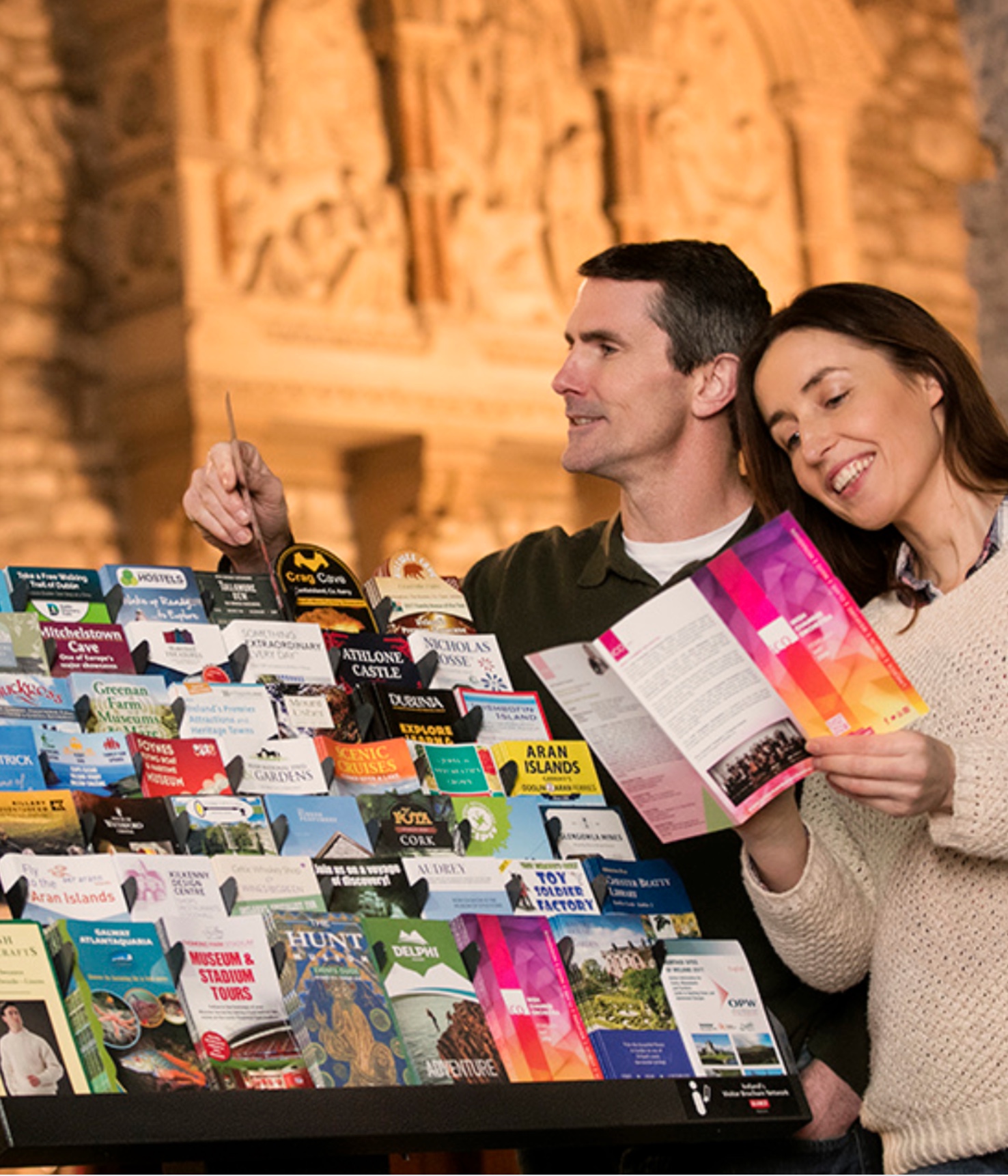
The Irish responses sit inside the international survey and track it closely on almost every measure. Where Ireland differs is in the mix of pick-up points.
Among women in Ireland, 63% picked up printed information in a hotel, 42% at an attraction, 37% at a visitor centre and 22% at a transport hub, with almost half picking up in more than one type of location across a single trip. Those are the in-destination points where an open plan meets a decision, and in Ireland brochure displays are serviced by Glance Visitor Med
ia, the Visitor International member here. They place and maintain brochure, map and guide displays across their network, and feature businesses in their own visitor guides and maps.
Being present at those points puts a business in front of the person making the decisions, at the moment and in the place the decision is made — someone travelling independently, free to change route, trusting what they chose themselves, checking online, showing it to the people travelling alongside them, and taking home what interested them.
________________________________________________________________________________________________________________________________
ABOUT THE RESEARCH
Visitor International Consumer Survey: independent research commissioned by the association, conducted between 1 July 2024 and 30 June 2026 across thirteen territories in English, French and German. It gathered 8,181 completed responses, unweighted and without quotas. Women accounted for 62% of respondents.
Most figures above are based on the 3,711 women who used a visitor brochure, map or guide; retention, trust and print-versus-digital figures use the wider female and full samples, as those questions were asked of everyone. Irish figures are based on the 546 women in Ireland who used a brochure, map or guide. Percentages are calculated on each question’s own valid base and rounded to the nearest whole percent. Results held across both twelve-month periods.
Influence figures describe the cumulative effect of all the printed visitor information a traveller encountered across a trip, not conversion by any single brochure, map or guide.
External figures on women’s share of travel decision-making come from Skift Research and from published studies of leisure travel planning and booking.
Visitor International is the global association of visitor information companies. Its member companies place brochure, map, guide and digital displays in hotels, attractions, transport hubs and other in-destination locations, and sell advertising within their own publications and networks. In Ireland, that member is Glance Visitor Media.

Watch out for them on your travels!