
Our business is guiding visitors to yours
Call 061 338 588
Much of today’s visitor marketing is non-stick. Think of where yours goes.
Advertisements are swiped away, skipped after five seconds, blocked, muted, paused or fast-forwarded. Others are lost among the pages of general-interest publications, or travel from doormat to recycling bin as unrequested mail drops. Messages pushed at people who never asked for them vanish into the fog of content overload. Most slide off their audiences as readily as an egg off a new frying pan.
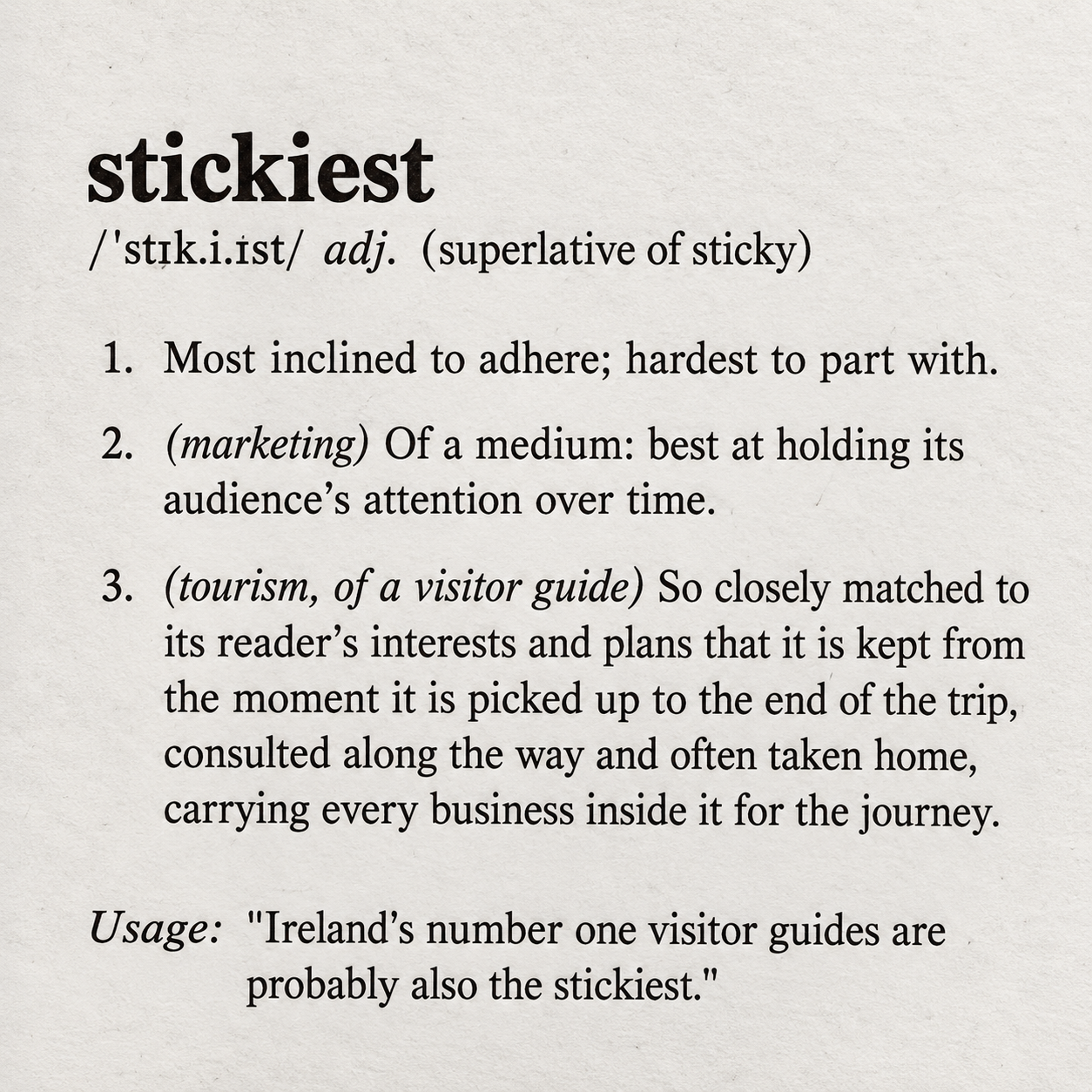
“Sticky” is seldom heard in marketing. At Glance, we think it deserves to be. A message that stays with its audience for days rather than seconds is priceless. So we have given its superlative, “stickiest”, a definition fit for the purpose.
Sticky visitor marketing works differently, and a good visitor guide shows how. It is presented to visitors rather than pushed at them, waiting in the hotel lobby, the tourist office, the train station, the visitor attraction, or the airport for the moment someone wants it. The visitor who picks it up is already interested, and finds it full of things that suit those interests: a guided tour for the morning, shopping or a castle visit for the afternoon, and entertainment tonight.
It goes beyond matching a plan. It suggests one, prompting ideas for today and tomorrow that the reader may never have considered. Each suggestion comes with what is needed to act on it: a detailed description, practical information and details on how to contact, book, or visit.
The Daily Adventure Visitor Guides are built to work this way. Visitors pick them up by choice because they want to know what to see and do. Each of the five editions is devoted to a single region, so nearly every page describes somewhere within reach. Each features attractions, activities and places to experience, which gives the reader a reason to open it today and again tomorrow. Every page links to the phone in the reader’s other hand through QR codes and web links. And the guides, in their 26th year, carry the trust earned over a quarter of a century of guiding visitors around Ireland.
Our 2026 Daily Adventure Reader Survey, still open, asks readers how long they keep the guide. Of the 1,729 who have replied so far, 87% keep it for their whole trip or take it home. More than six in ten also take it home as a memento or for future reference.
More striking than the level is its evenness. Couples, families and friends travelling together keep the guide at rates of 87–88%, and solo travellers at 84%. Those travelling by car, coach or train range from 86% to 87%. Every regional edition lands between 86% and 88%. Stickiness, it seems, belongs to the guide rather than to any particular type of reader.
Each audience keeps the guide in its own way. Overseas visitors keep it close throughout their travels, with 71% holding on to it until they reach their place of inter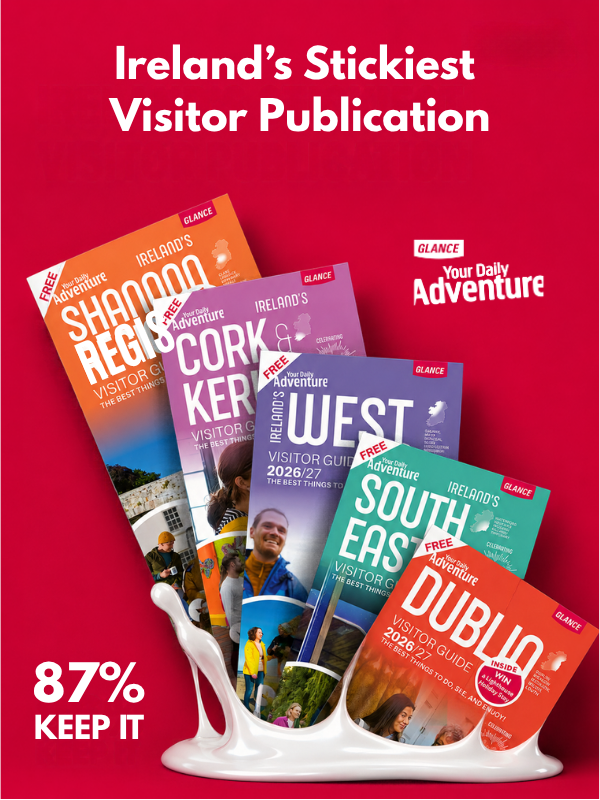 est or for the whole trip. Irish residents put it to work on this trip and the next: 88% keep it for the trip or take it home, and 64% bring it home to plan their next visit. Stickiness also tracks value: among readers who rate the guide extremely valuable, 91% keep it for the trip or take it home.
Stickiness can be measured. Online, for instance, attention is counted in seconds on a page. The Daily Adventure counts it in days, in miles travelled and in trips still to come across a full season. So the question for any marketer is a simple one: how long does your audience keep your message?
For businesses featured in The Daily Adventure, the answer comes twice over. The guide is published annually and stays in circulation for the full tourism season, reaching new visitors every day it is on the shelves. The vast majority of those visitors (almost 9 in 10) then carries it for the whole of their trip or often long after it. By that measure, Ireland’s number one visitor guides are probably also its stickiest.
All figures come from the 2026 Daily Adventure Reader Survey: 1,729 responses received between 27 March and 30 September 2026, across all five regional editions – Dublin, Cork-Kerry, Ireland West, South East and Dublin. The survey ends 23 October 2026.

Watch out for them on your travels!